
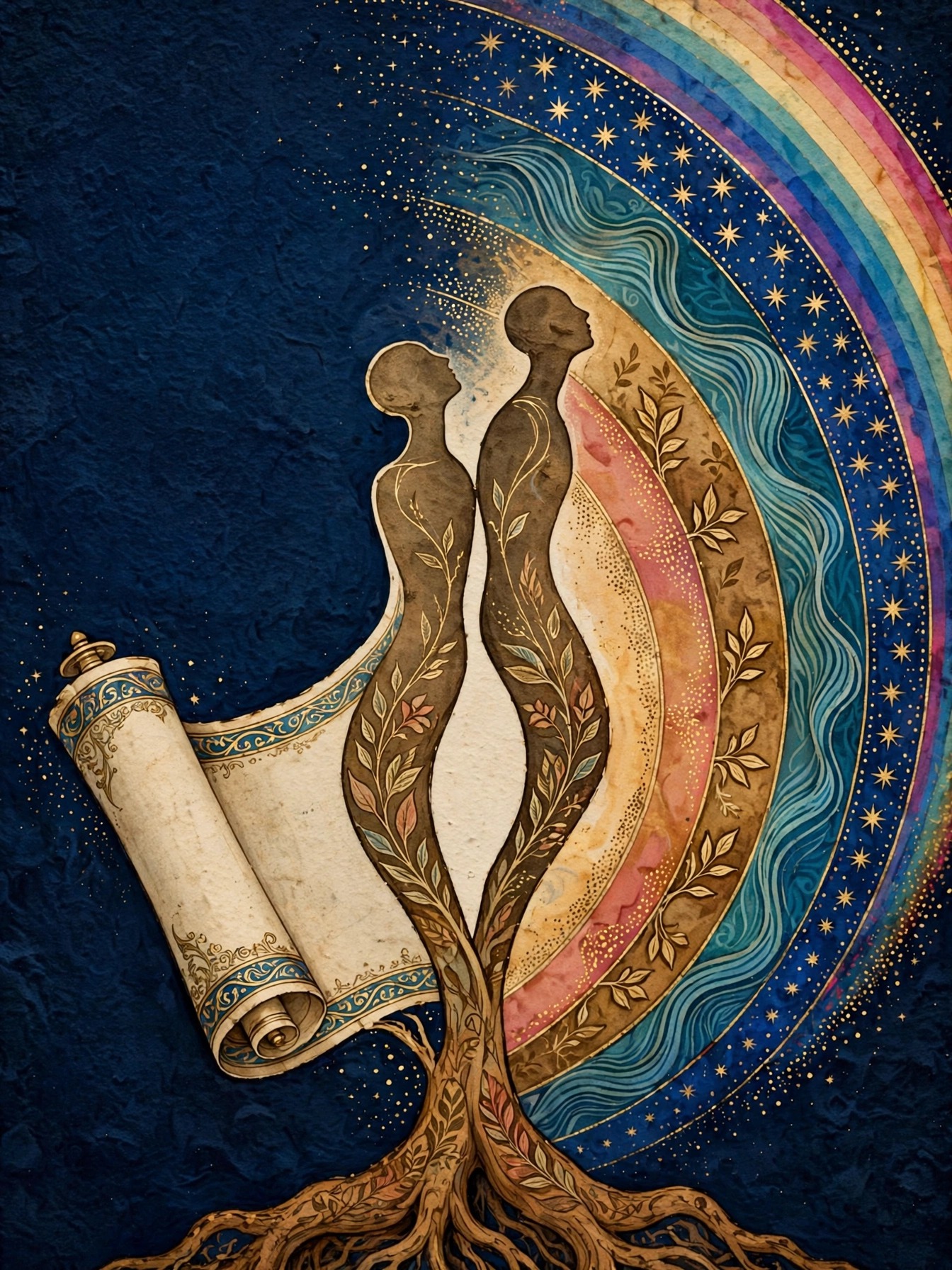
In the Beginning, More Than a Binary
Genesis 1:1–6:8 · read through an LGBTQ+ lens
Read on Shabbat, 29 Tishrei 5787 · October 10, 2026
A queer Jewish study of creation, embodiment, companionship, and the expansive image of God. Core question: what becomes visible when we read the text beside its own interpretive plurality?
Key Texts
Genesis 1:27 · בְּצֶלֶם אֱלֹהִים בָּרָא אֹתוֹ · זָכָר וּנְקֵבָה בָּרָא אֹתָם
“In the image of God … male and female God created them.” Genesis names humanity b’tzelem Elohim — in the image of God — before it names “male and female.” Margaret Moers Wenig reads that sequence as a claim that LGBTQ people and their orientations belong to creation’s original design.
Genesis 2:7, 21–22 — Rib, or side? · וַיִּקַּח אַחַת מִצַּלְעֹתָיו
God forms ha-adam, the earthling, from adamah — earth — then takes one tzela. Ramban retains the rib reading; Genesis Rabbah 8:1 reads tzela as a whole side: an originally double-faced human, separated into two. Joy Ladin: gender differentiation is not the human’s starting condition.
Genesis 2:18 · לֹא־טוֹב הֱיוֹת הָאָדָם לְבַדּוֹ
“It is not good for the human to be alone; I will make a strong help corresponding to them.” Before disobedience, shame, or exile, the text calls one thing lo tov — not good: human aloneness. The stated problem is aloneness, not childlessness; ezer k’negdo is a counterpart who meets the other face to face.
Genesis 2:24 · וְהָיוּ לְבָשָׂר אֶחָד
“He cleaves to his wife, and they become one flesh.” The full guide keeps the restrictive rabbinic use of this verse visible. Other readers understand it as description, not universal prescription: davaq names loyal attachment, and “one flesh” can name kinship and household, not only reproduction.
Six categories in the rabbinic archive
Rabbinic literature did not reduce every body to one of two legal categories: zakhar, nekeivah, androgynos, tumtum, saris, aylonit. These are ancient legal classifications, not simple equivalents for modern identities — but they unsettle the claim that gender complexity is new.
Discussion Questions
Choose two texts and three questions. Read aloud, sit with the friction, and resist racing to consensus.
- What changes when ha-adam is translated “the earthling” rather than “the man”?
- Does “male and female” set a boundary — or name the outer points of an abundant whole?
- If every person is made in the divine image, what obligations follow for language, ritual, and communal belonging?
- What is gained — and what is risked — when modern identities are mapped onto ancient categories?
- Is the core of Genesis 2 reproduction, companionship, kinship, or something else?
- Where do you see interpretation repairing a wound in the text? Where might it conceal one?
The 75-Minute Session
- 10 min — Read Genesis 1:26–28 and 2:7, 18–24 aloud.
- 20 min — Chevruta on the two creation accounts.
- 20 min — Study Genesis Rabbah 8:1 beside Ladin or Wenig.
- 15 min — Discuss one rabbinic category and its limits.
- 10 min — Closing round — one teaching, one remaining tension.
Downloads
📥 Download the Bereshit One-Page Handout (PDF)
📥 Download the full Bereshit Deep Dive (PDF)
Coming Next: Noach — 6 Cheshvan 5787 · October 17, 2026
