After the Flood, a Spectrum
Genesis 6:9–11:32 · read through an LGBTQ+ lens
Read on Shabbat, 6 Cheshvan 5787 · October 17, 2026
A queer Jewish study of survival, covenant, domination, difference — and what it takes to build a world where many kinds of life can flourish.
Care note: this study names sexual violence, trauma, homophobic interpretation, and the racialized misuse of the “curse of Ham” directly rather than softening them.
Key Texts
Genesis 9:16 — The bow in the clouds
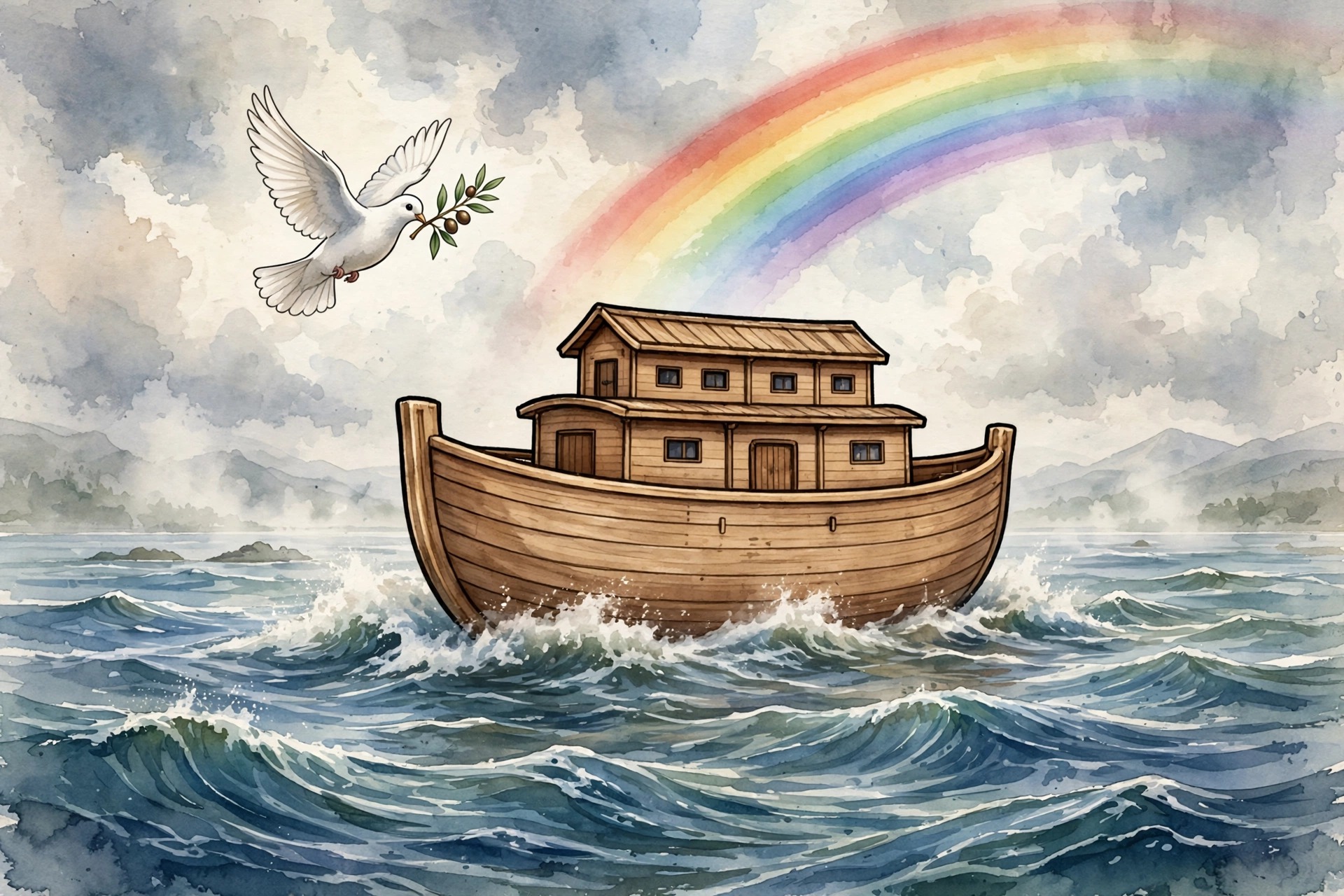
“When the bow is in the clouds, I will see it and remember the everlasting covenant.” Keshet means rainbow — and ordinarily, a war bow. Ramban reads it as a bow without its string, pointed away from the earth: a weapon rendered harmless. The covenant is made not only with one family or nation, but with “every living creature.”
Genesis 9:18–27 · Sanhedrin 70a — Inside the tent
Ham “saw” Noah’s nakedness, yet Noah wakes and knows what had been “done to him.” Rav and Shmuel disagree: one says Ham castrated Noah; the other, that he sexually assaulted him. Rabbi Steven Greenberg reads it as domination, not desire: “The parasha then is not about male-male sex per se. There is no punishment for queer sex here.” Michael Sarid adds the ethics of witnessing: Shem and Japheth refuse the gaze and cover their father.
Sanhedrin 108a — What sealed the decree?
Genesis names vatishachet, corruption, and chamas, violence. Some midrashim bundle male-male union with coercion and robbery — a stigma the full guide does not disguise. But Sanhedrin 108a draws its own hierarchy: the decree was sealed because of theft. The parashah’s controlling moral category is violence — violation of bodies, property, and boundaries — not loving relationship.
Genesis 6:9 — Righteous in his generation
Tzaddik be-dorotav is heard two ways: praise — righteous even in such a generation — or limit — only righteous by comparison. Noah “walked with God”; Abraham is told to “walk before Me.” Noah names the lonely integrity of being the only out person in the room — and the ark is both necessary refuge and insufficient politics: survival, then the harder obligation to remake the world outside it.
Genesis 11:1–9 — Babel
The builders fear being scattered. The Netziv reads their project as a regime of enforced ideology; Rabbi Jonathan Sacks calls the tower “an artificial unity” imposed on divinely created diversity. God does not end communication. God ends the monopoly of one language.
Discussion Questions
- What would it mean to take a symbol once aimed at us and hang it up as a sign of covenant? What does reclamation cost?
- The rainbow covenant includes “every living creature” and requires nothing of its recipients. How does that speak to experiences of conditional welcome?
- Do you find Greenberg’s distinction between queer sex and sex used as domination persuasive? What changes when harm — not gender — is the moral axis?
- Which reading of Ham moves you more: sexualized domination, or witnessing suffering and walking away? What responsibility follows from each?
- How does reading Noah’s drinking as a trauma response rather than simple disgrace change the story?
- When has survival itself been righteousness? When did the moment demand more — the move from Noah’s refuge to Abraham’s protest?
- Where do you encounter pressure toward “one language” in Jewish life, queer life, or public life? What might holy scattering look like?
- What do we do with inherited texts whose stigma cannot be wished away, even when their broader moral logic points toward violence and exploitation?
A 25-Minute Study Circle
- 3 min · Arrive — Read Genesis 9:8–17 aloud.
- 6 min · Notice — What does this covenant require — and of whom?
- 8 min · Choose — Open one discussion question and study in pairs.
- 6 min · Gather — Name one interpretation that changed the text for you.
- 2 min · Close — Offer the traditional rainbow blessing or a moment of silence.
Downloads
📥 Download the Noach One-Page Handout (PDF)
📥 Download the full Noach Deep Dive (PDF)
Coming Next: Lech-Lecha — 13 Cheshvan 5787 · October 24, 2026
